— Sermon Audio —
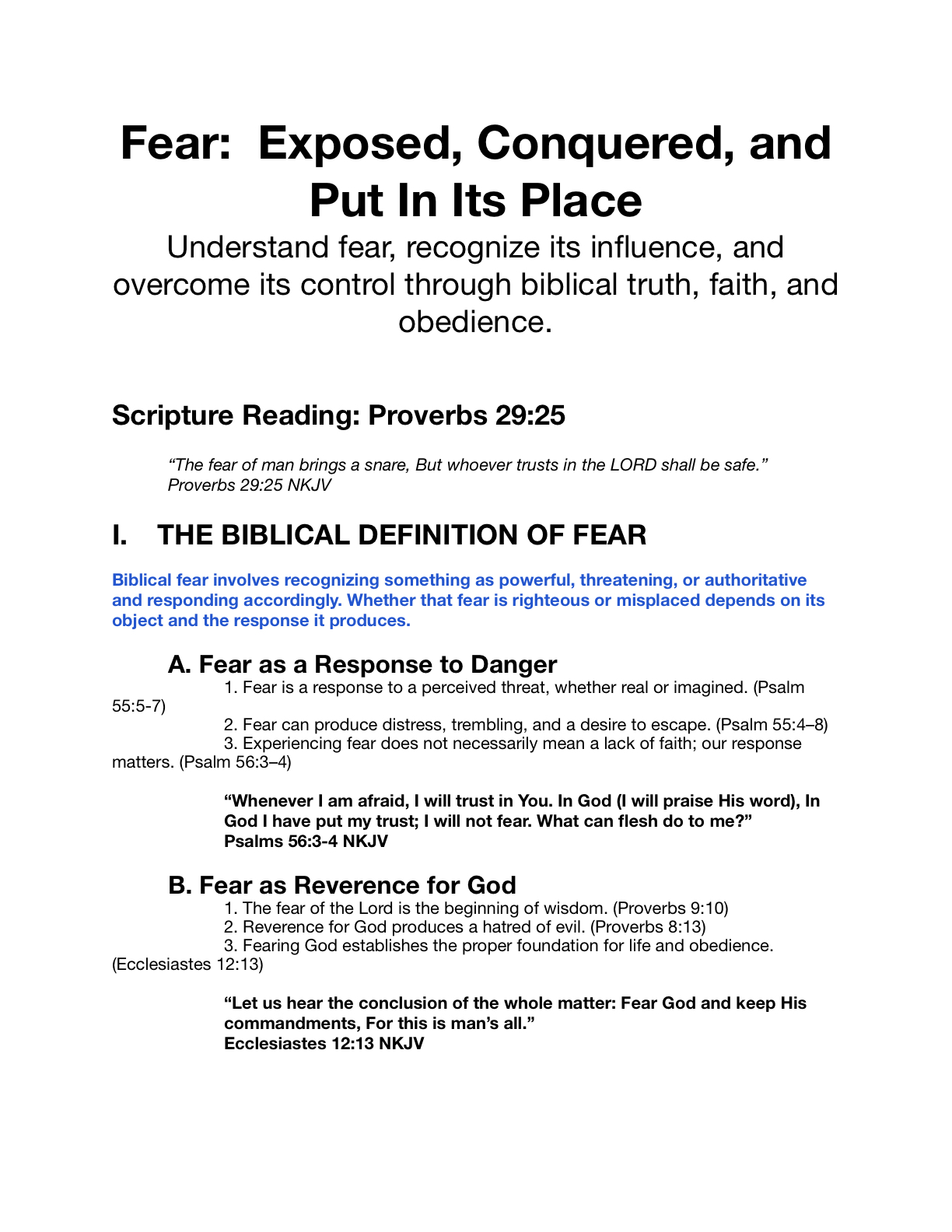
Fear: Exposed, Conquered, and Put in Its Place
“The fear of man bringeth a snare: but whoso putteth his trust in the LORD shall be safe” (Proverbs 29:25, KJV). That verse puts a question in front of us: whose judgment carries the most weight when we decide what to do?
Part of my work at Nestlé involves creating training materials. One thing I’ve learned is that you can’t teach someone very much if you’re using words they don’t understand. People may nod along, but nodding isn’t the same as understanding.
We can do the same thing with the Bible. We hear words like faith, grace, and fear so often that we assume everyone understands them. But before we can deal with fear biblically, we need to understand what Scripture is describing.
What Does the Bible Mean by Fear?
The Bible describes fear in more than one setting. Sometimes it involves danger and the desire to escape; sometimes it means reverence for God. Sometimes it becomes the reason we disobey what we know is right. We have to look at what a person fears and what that fear leads them to do.
David didn’t hide the distress he experienced. He described trembling, horror, and a longing to fly away and find rest. Those are the words of someone who felt overwhelmed, not someone who had never known God (Psalm 55:4–8).
Elsewhere, David wrote, “What time I am afraid, I will trust in thee.” Notice that he acknowledged being afraid and then expressed his trust in God. Feeling fear and responding with faith can happen in the same struggle (Psalm 56:3–4).
We should also leave room for wise caution. Proverbs describes a wise person who fears and departs from evil, while the fool charges ahead confidently. The biblical answer to fear isn’t to ignore danger or prove how daring we can be; it is to respond wisely under God’s authority (Proverbs 14:15–16).
The Fear That Belongs in Our Lives
The fear of the Lord belongs at the foundation of how we live. Scripture connects it with wisdom, hatred of evil, and obedience. Reverence for God reaches beyond what we say about Him on Sunday; it affects what we are willing to do on Monday (Proverbs 9:10; Proverbs 8:13; Ecclesiastes 12:13–14).
For the Christian, this reverence stands alongside the forgiveness and reconciliation we have through Jesus Christ. We approach God because Christ shed His blood, died for us, and rose again. Our obedience grows from belonging to Him, and His holiness still deserves our reverence (Colossians 1:13–22; Colossians 2:12–14).
That gives us a different starting point when fear comes. We can bring our struggle before the God who has redeemed us, rather than treating ourselves as people who must solve everything alone. Our life is now bound to Christ, and that truth should shape how we face what lies ahead (Colossians 3:1–4).
When Fear Starts Making the Decisions
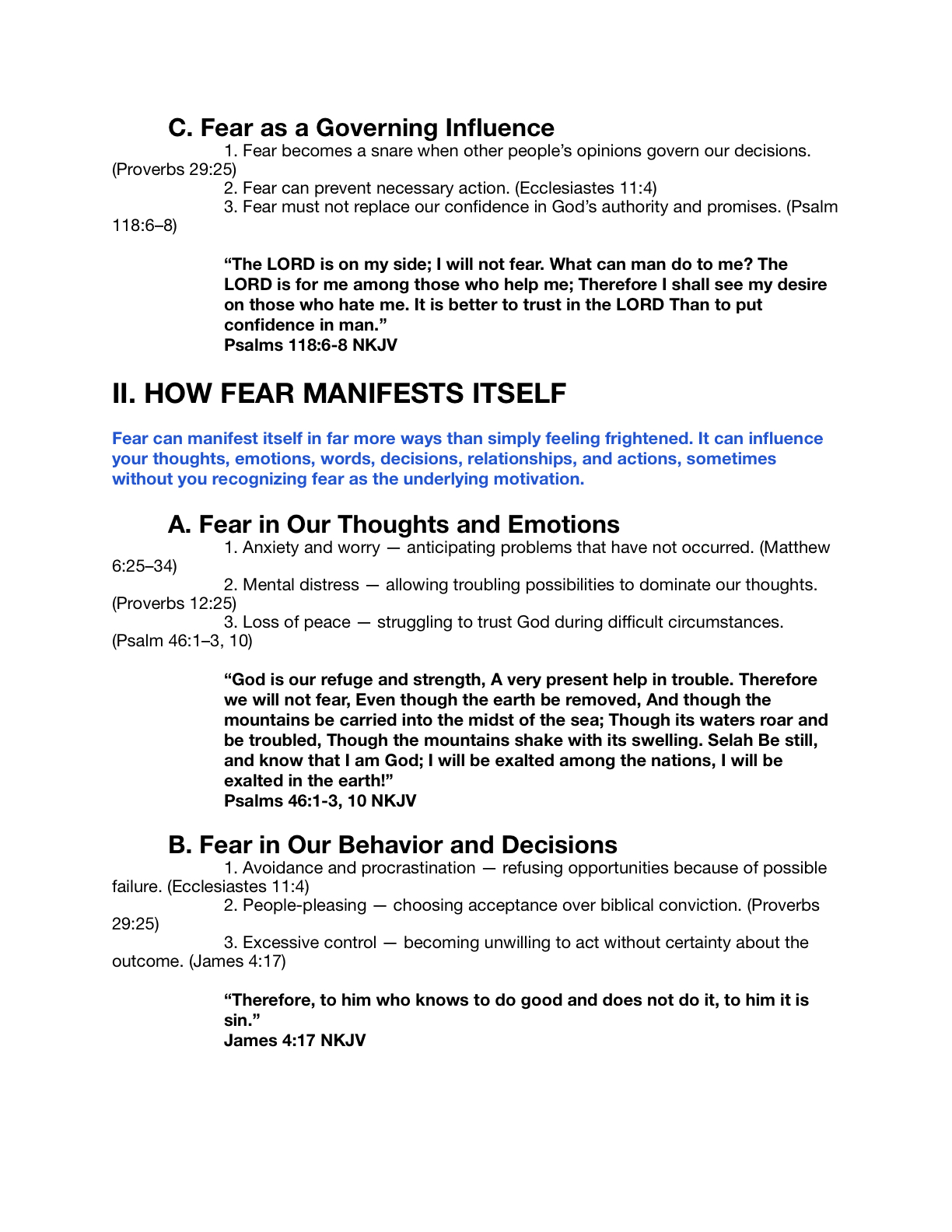
The snare in Proverbs becomes easy to recognize when someone else’s opinion starts governing our obedience. We know we should speak honestly, but we wonder whether the person will get angry. We know we should refuse something wrong, but we don’t want to lose acceptance (Proverbs 29:25).
I’ve had to examine that in myself. Will people dislike what I say? Will speaking plainly damage a relationship? Those questions may deserve consideration, but they cannot become the authority that decides whether I obey God. Scripture directs our confidence toward the Lord above the approval of people (Psalm 118:6–8).
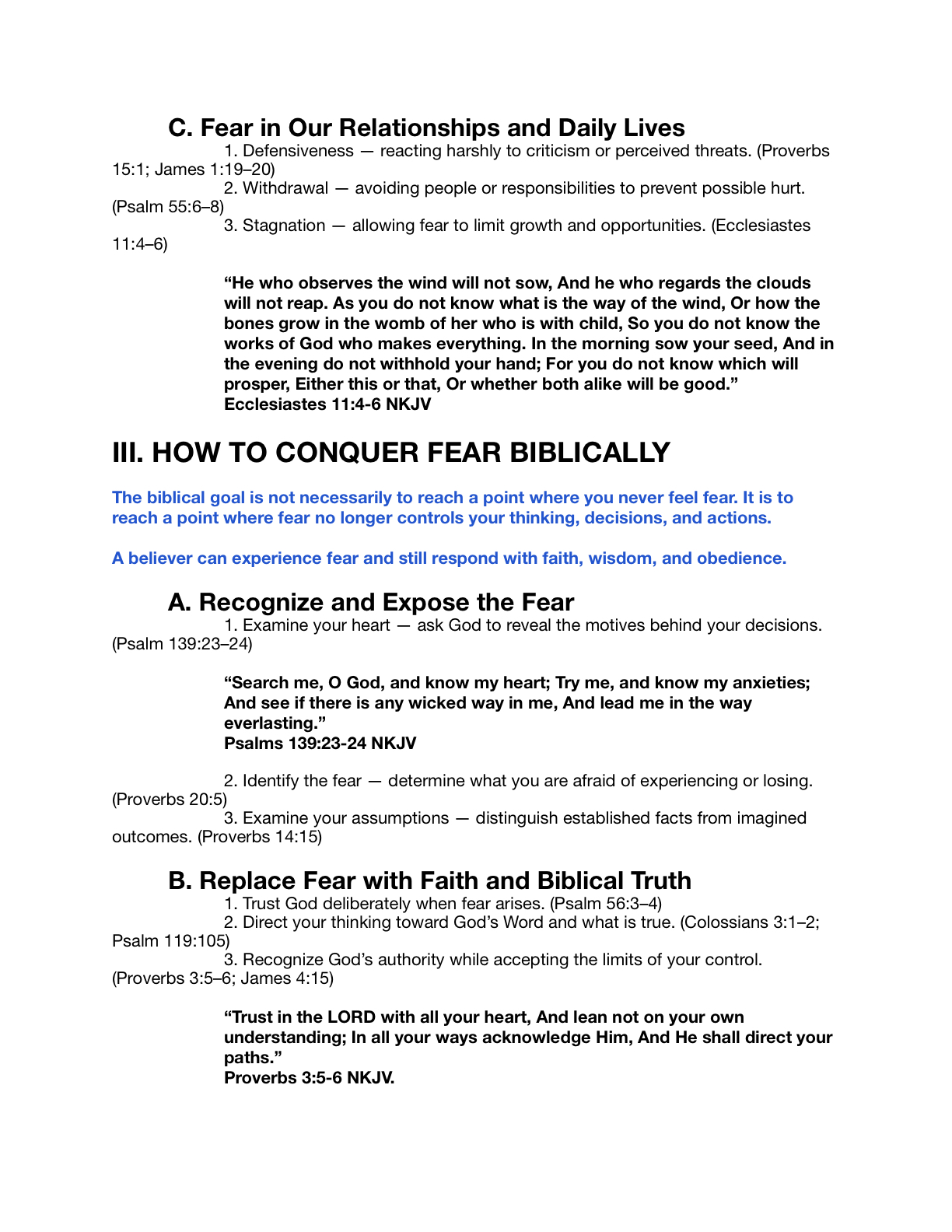
Fear can also keep us waiting for certainty. Ecclesiastes pictures a person watching the wind and clouds instead of planting and harvesting. The passage acknowledges how much we don’t know, yet still tells us to sow. We aren’t promised complete knowledge before we act (Ecclesiastes 11:4–6).
James brings that responsibility home. Knowing the good we ought to do and refusing to do it is sin. We should plan humbly, recognizing that our lives and plans depend on the Lord, while still doing the good already placed before us (James 4:13–17).
Fear Doesn’t Always Look Frightened
Jesus addressed worry about food, clothing, and tomorrow. Those are ordinary concerns, which makes His teaching close to home. He directed His hearers toward their Father’s care and toward seeking God’s kingdom and righteousness instead of being consumed by tomorrow’s needs (Matthew 6:25–34).
Proverbs describes heaviness making a person’s heart stoop. David described wanting to escape, and James warned against being quick to speak and quick to anger. These passages give us reasons to examine our distress and conduct, though they don’t establish that every instance of sadness, withdrawal, or anger comes from fear (Proverbs 12:25; Psalm 55:6–8; James 1:19–20).
A useful question is whether fear is hiding underneath a particular response. Am I delaying because I need more information, or because I don’t want to risk being wrong? Am I answering harshly because I’m defending the truth, or because criticism has touched something I’m afraid to face? Scripture calls us to examine our ways and answer with restraint (Proverbs 14:15; Proverbs 15:1; James 1:19–20).
What the Studies Actually Show
In my sermon, I mentioned research involving sugarcane farmers. Researchers tested the same farmers before harvest, when money was scarce, and after harvest, when their financial position had improved. The farmers performed better on cognitive tests after harvest, and the researchers proposed that financial concerns consumed mental resources. This supports a careful point about financial strain and cognitive performance; it doesn’t establish that fear permanently lowers intelligence or that frightened people always make bad decisions (Mani, Mullainathan, Shafir, and Zhao, 2013, “Poverty Impedes Cognitive Function”). zhaolab.psych.ubc.ca
I also mentioned the connection between emotional hurt and physical pain. One study found that social exclusion activated a brain region associated with the distress of physical pain. Another found overlapping activation in additional pain-related regions when people recalled an unwanted romantic breakup. These findings show overlap in particular circumstances, rather than proving that every emotional hurt and physical injury produce identical brain responses (Eisenberger, Lieberman, and Williams, 2003, “Does Rejection Hurt?”; Kross and colleagues, 2011, “Social Rejection Shares Somatosensory Representations with Physical Pain”). pubmed.ncbi.nlm.nih.gov
These studies help describe human difficulties. They don’t decide what is righteous, establish why a particular person is struggling, or measure anyone’s faith. Scripture supplies our moral direction, including the responsibility to support the weak and show patience toward everyone (1 Thessalonians 5:14).
When Yesterday Starts Deciding Today
Years ago, I experienced a serious breakdown during a period when I was working long hours, neglecting rest, and failing to care for myself. That experience stayed with me. Much later, when additional paid work became available, I hesitated because I associated longer hours with what had happened before.
At the same time, I had been praying for some additional income. I wasn’t asking to become wealthy; I wanted a little more room in the household budget. An opportunity was available, but I needed to examine whether my hesitation reflected present circumstances or an assumption carried forward from the past.
Eventually, I tried a longer week while continuing to pay attention to sleep, food, and exercise. That particular week went well. It gave me a reason to reconsider the idea that any increase in work would necessarily produce the same result as before.
My experience doesn’t establish how many hours someone else should work, or how every future week will go for me. The lesson I drew was narrower: I needed to examine the decision honestly instead of assuming I already knew the outcome. We can acknowledge uncertainty, consider our responsibilities, and act without pretending we control everything (Proverbs 14:15; Ecclesiastes 11:4–6; James 4:15).
First, Bring the Fear Into the Light
David prayed, “Search me, O God, and know my heart: try me, and know my thoughts.” He also asked God to reveal any wicked way and lead him in the everlasting way. That is an honest place to begin when we don’t understand our own motives (Psalm 139:23–24).
Put the concern into words. Perhaps you’re afraid of rejection, financial loss, embarrassment, or repeating a painful experience. Proverbs compares counsel in the heart to deep water; understanding involves drawing it out. Naming the concern is a suggested way to begin that examination (Proverbs 20:5).
Then look carefully at what you actually know. What has happened, and what are you predicting? What needs attention now, and what are you treating as certain without evidence? Prudence considers the path ahead rather than believing every claim, including the claims we make to ourselves (Proverbs 14:15).
Give God’s Word Your Attention
Once you’ve identified the concern, study the passages that address it. Read the surrounding verses, consider what they mean, and resist making promises the text doesn’t make. God’s Word is a lamp for our feet, and our thinking should be directed toward the things of Christ (Psalm 119:105; Colossians 3:1–2).
You can read a passage aloud, write it down, and return to it during the day. Treat that as a way to give attention to its meaning, rather than expecting the act of speaking to guarantee an outcome. The question remains whether you are receiving and doing what Scripture teaches (James 1:21–25).
Psalm 46 describes upheaval on a scale far beyond an inconvenient afternoon. Mountains move, waters roar, and kingdoms are shaken, yet God remains the refuge of His people. Its call to be still rests on who God is, even while the circumstances are frightening (Psalm 46:1–3, 10).
Trust also means accepting the limits of your understanding. You can consider the facts, seek wisdom, and make a responsible decision without knowing everything that will follow. Acknowledge God in your ways, commit your path to Him, and leave the results in His hands (Proverbs 3:5–6; Psalm 37:5; James 4:15).
Take the Next Obedient Step
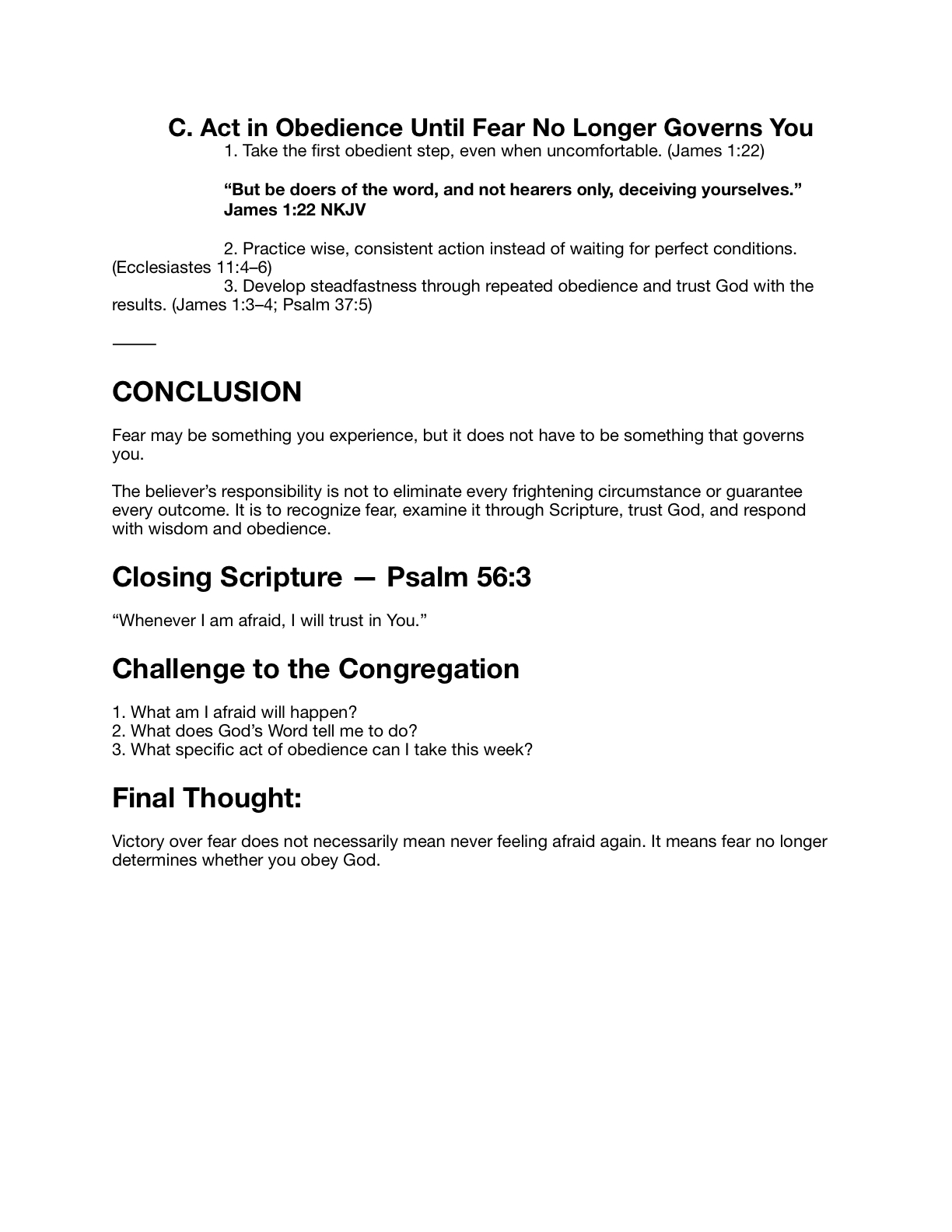
James tells us to be doers of the Word. Hearing the right instruction while continually refusing to act leaves us deceiving ourselves. When the duty is clear, the next question is how we will carry it out (James 1:22).
Think about someone returning to the weight room after years away. Loading the bench with 315 pounds won’t prove much if the person can’t lift it. As an illustration, that is how I think about practicing obedience: take the responsibility seriously and choose a concrete action you can carry out, rather than making a grand announcement about changing everything at once.
If you’ve been avoiding an honest conversation, arrange a time and prepare to speak gently. If criticism makes you defensive, practice listening before answering. If you’ve neglected a clear responsibility while waiting for ideal conditions, decide when you will begin. These are practical applications of speaking with restraint, doing what is right, and working amid uncertainty (Proverbs 15:1; James 1:19–22; Ecclesiastes 11:4–6).
For the coming week, set aside a brief time each day to read, pray, and identify one duty you need to carry out. Write down what you did and what you still need to address. I keep records because they give me something concrete to review; the aim is faithful action, with patient endurance as faith is tried (James 1:3–4).
Fear Can Be Present Without Governing You
Ask yourself three questions this week: What am I afraid will happen? What does God’s Word tell me to do? What specific act of obedience can I take? Give yourself time to answer honestly, then carry out the responsibility you have identified (Psalm 139:23–24; James 1:22).
David’s words remain a fitting response: “What time I am afraid, I will trust in thee.” You may still feel the struggle as you act. Victory over fear means that fear no longer gets to decide whether you obey God (Psalm 56:3–4).
— Sermon Notes —